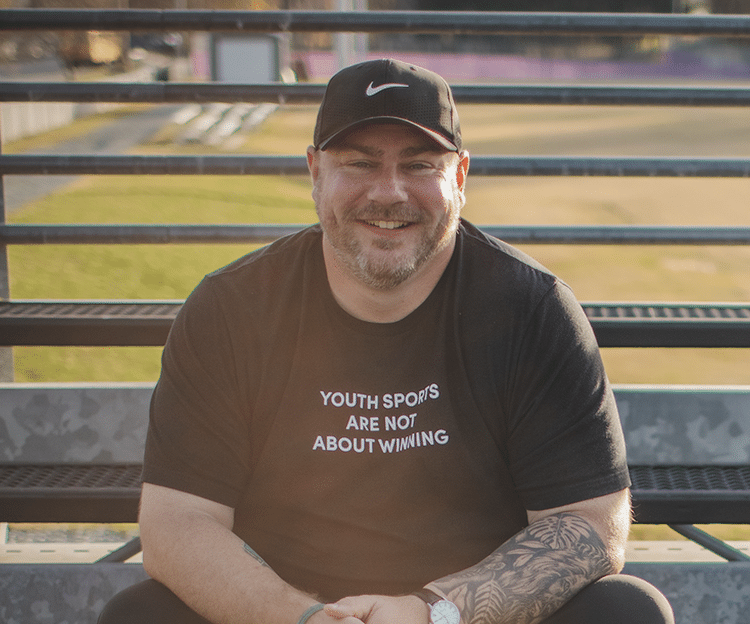
If you have a kid in sports or played sports growing up, you know that youth sports can be an amazing part of childhood. Sports are not only fun, but can teach so much about grit and teamwork. Plus, they help kids build healthy habits to last a lifetime.
On the flip side, the landscape of youth sports has changed since we were kids, with travel sports starting earlier, the cost to play greater, and the pressure on both parents and kids to commit year-round higher. Recently, Momcast, the podcast powered by The Local Moms Network, featured Healthy Sports Parents founder Jonathan Carone, to talk about some of this huge topic of parenting.
Host of the popular podcast of the same name, Jonathan draws on his career background in sports management and coaching (from kids to Division 1 athletes) in order to help parents navigate the youth sports landscape in a way that’s healthy for both kids and families.
He shared with host Demetra Ganias how he decided to start his platform after his 9-year-old daughter’s soccer game, where he saw another dad make his daughter cry. “I looked at that dude in the moment and I had sympathy for the daughter, but I also had empathy for that dad. I realized that I’m not terribly far off from doing that,” says Jonathan. He added: “I knew that dad did not wake up that morning saying, ‘You know what sounds really fun today? I want to make my daughter cry on the side of the soccer field.’”
So Jonathan sat down and planned his first few podcast interviews. “The second week the show was on the air, I did my first at the Rec League video, and it got 6 million views in two weeks. So I went from nothing to like 25, 000 followers over the course of a weekend.”
Below, read an excerpt of the interview. It’s also a must-listen, so check out the whole conversation by downloading it on Momcast.
Jumping right in, like you said, parents don’t want to make their kids cry. So why are we so triggered?
So I think it comes down to two ideas, self-love and self-glory; these are 100% natural ideas. We want other people to like us…and we want other people to think we’re good at what we do. And so where it gets toxic and unhealthy is when we think others like us more because our kids perform better on the field, or we think they think we’re a better parent if our kid is performing well.
So it’s really about us?
Youth sports hold up a mirror to our deepest insecurities. And we don’t realize we have some of these things going on inside of us until your kid’s on the mound and they just walked three kids. And it’s like, why am I feeling so embarrassed that my kid is performing like this? Like, I love the kid no matter what. I’m not the one on the field. I’ve seen the work. It’s just a bad performance. They’re too young for it to matter right now. So who cares?
But how many people do you know who are in their 20s, 30s, 40s who are still trying to get their parents’ approval? And how many stupid things do we do as adults because we’re still trying to earn the love of our parents? So [what] if we can be intentional about showing our kids now through sports that we love them no matter what, and that their performance does not make us any more or less proud of them? Then when they’re in their 20s and 30s and they’re confident in our pride and love for them, how much freedom will they have to go out and do what they were made for, not necessarily try to earn our love—because they know they have it.
So why are we here then?
We are here to develop autonomous human beings who have every tool they need to have success as adults at whatever they want to do. We’re just using sports as the avenue to do that. So yes, we want to win. We are going to try to win, but winning is not the point. Learning the process needed to win is the point, because the process is what we use in life once these games are over.
It can seem like the goal is D-1 or nothing…
So if that’s our mindset, we’re setting ourselves up for failure. But if we’re using these games to develop human beings who have every tool they need to have success once they’re out of our house, then we can look at it as like, I’m investing in an adult here. I’m not trying to create the next Aaron Judge or the next Lionel Messi or the next Wayne Gretzky. I am creating the best version of my child possible, and we’re just using sports to do that. Are they a good teammate? Are they coachable? Do they have a good work ethic? Are they able to push through when things get hard? Are they able to bounce back from it? If we can instill those things in our kids at 9, 12, 14, through sports, then when they get to college and things get hard for the first time or when they get in their job at 25 years old, and they have a boss they don’t necessarily like and a job they don’t love, are they able to keep going? We’re trying to create an atmosphere where our kids can thrive as human beings. If we get a great athlete in the process, that’s just gravy on top.
Let’s talk about failure—how do you handle that?
So you win or you learn. You don’t fail. I tell every kid I coach, I want them to make mistakes. If you’re making mistakes because you’re trying, that means you’re learning. That means you had the bravery to go out and do something hard, that you didn’t wait until you had it perfected before you went out and did it.
What is your take on specializing at a young age?
I think we can understand, on one hand, that a multi-sport athlete is going to be healthier long term, and is going to use their body in a different way that makes them better in the long run. On the other hand, we have to acknowledge the culture that we’re in. So, I’m in a town where our high school is only 850 kids. To play soccer at my high school, all you have to do is show up with a physical and a pair of shinguards, and you’re going to make the team. If I go 20 minutes down the road to that 2,800 person high school, those kids start specializing at eight years old. And so the competition to get into the middle school team or the high school team is significantly higher than it is where I live. So what is best isn’t always what is possible. Ideally, we’re playing multiple sports through elementary school at the least. I say to treat it like a buffet. Like, let’s go play all the sports, see what we want. And then by middle school, hopefully, we’ve locked in on our one or two that we really like.
Last question, Jonathan. What is the one thing parents should be saying to their kids on the ride home after a game?
I love you. I enjoyed watching you play. Where do you want to eat? What do you want to listen to? If they want feedback on how they played, they will ask. Otherwise, the car ride home is your place for them to make them feel loved and to show your pride in them. If you have critique, if it’s an effort thing, whatever, do it at another time because unless they’re asking for it, that emotionally charged ride home is not the place that’s going to lead to long-term change.
Don’t forget to check out the whole conversation with Jonathan Carone (below) by downloading it on Momcast.